

The Little Things: What was in an Old West Traveler's Pockets?

Updated: May 31
What would you carry in your pockets if you lived in the Old West? Here's a Glimpse at some items carried by 19th Century Frontier Americans
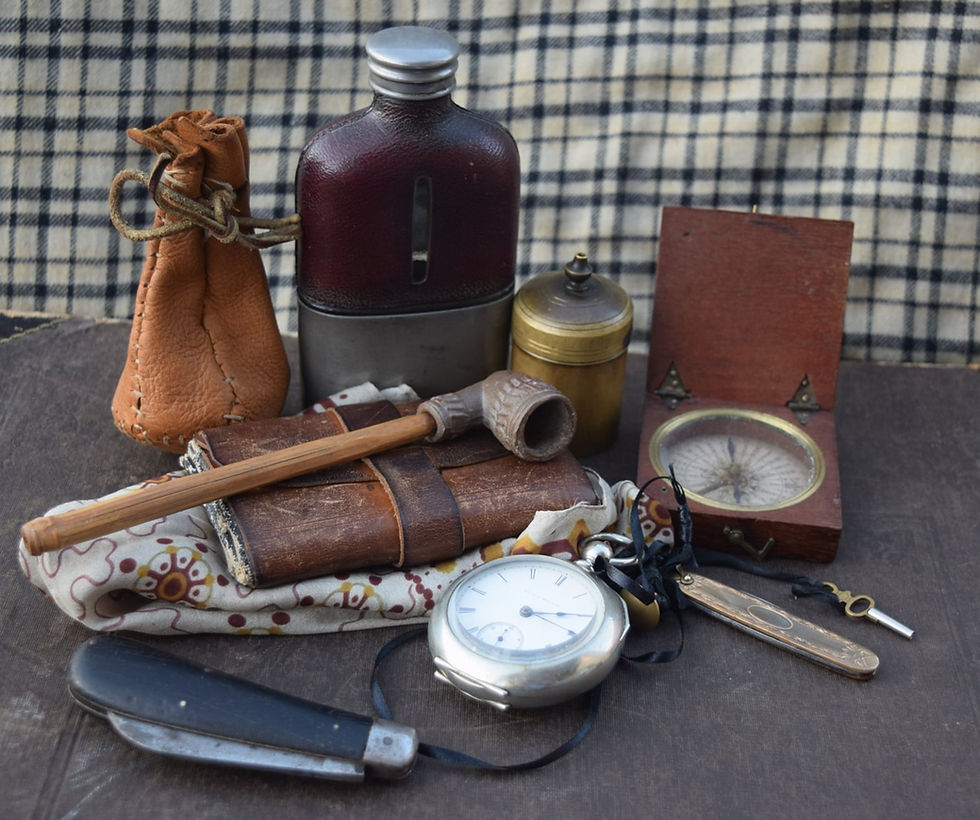
"In the 21st century, we have traded self reliance and valuable life skills for digital convenience and instant dopamine."

Dave Rodgers is Chief Editor of the Frontier American Illustrated News. He is a tribal member and westerner descended directly from Squire and Edward Boone (father & brother of Daniel Boone). With an old-west family lineage of farmers, ranchers, railway men, lawmen and desperadoes, he takes pride in the rich story of the land his family came from. As a resident of rural Arizona, he continues in the traditions of the American West and promotes the western culture as it continues on today.
Think of all the convenience that a smart phone brings to our lives. You are likely reading this article on one right now. It instantly connects us with data centers around the world brimming with digital archives of countless videos, images and articles. There are a multitude of service apps, instant communication, even a compass, camera, and flashlight. But what if it was all taken away? What if suddenly, the grid went down and there was no guarantee it would be up any time soon?
In the 21st century, we have traded self reliance and valuable life skills for digital convenience and instant dopamine. Just like us, people of the old west had schedules to keep, bills to pay, messages to send, and a need to fix life's little emergencies. The tools they carried to accomplish these tasks were more cumbersome, but they were not vulnerable to poor signal strength and power outages. So, what were they and how were they used? Here are some of the most common items that Americans in the old west carried.
The Old Ways Were Non-Electric & There Was More to Carry

Our western ancestors were still able to track the time, keep a schedule, and read up on current events but they also were able to live more comfortably under primitive conditions. A pocket knife was carried as a common-use tool and few people today carry any means of making fire with them unless they smoke. Since most smokers now vape, matches have become even more of a novelty.
Here is a quick overview with special mention to supplementary items that would be found in 19th century pockets, saddlebag, or valise.

Don't Overload Yourself


This article is about identifying the kind of things found in an 18th century pocket but it does not mean that ALL of these items were carried at once. Many men and women went about their daily business as unencumbered as possible just as we do today. An emigrant, traveler or working tradesman would likely carry a full kit. A local farmer or laborer going about their town or homestead may likely have as little as an old kerchief and a jackknife in their pocket.
Tools of Navigation Across the American Continent

Travel was more intensive than today. If the destination was not reached by water or rail, travelers relied on local maps, travel guides and the tools of navigation.

Travel Guides - Just like today, travel guides gave advice on transportation routes, rail, wagon, coach, and water travel, hotel rates and even, advice against criminal activity as well as preparations needed for the trip. More important, these guides gave emigrants and teamsters vital information about the route, water, forage and fuel availability. Information such as how much food should be carried, water casks capacity, clothing, tools, camp supplies, arms and even advice on cooperation between travelers on a long distance could be found in such books.

Compass - At this point, it was an ancient form of navigation but still an effective one as we continue our reliance upon its use. Knowing your true bearings will mean the difference between staying on the path to key landmarks, rendezvous points, & watering holes, or missing all these locations by miles. Only a novice traveler fancies his ability to stay on course without the aid of a compass when traveling over great distances.
Keeping Time: Watches & Almanacs

Pocket watches
Contrary to popular belief, pocket watches upon the western frontier were actually quite common even with working class people. Watches were far more expensive previous to the industrial revolution but by the mid-1800s a variety of makers across the US and Europe were selling inexpensive timepieces that most people could afford. Such common workaday watches could be obtained for around $1.25 - $2.00 while a Colt's Revolver averaged selling for $12 or more.
Pocket watches were essential for maintaining the day's scheduled events just as we still do today. Watches were also useful for commercial transportation by managing time between destination points for caravans and the following railroads as they carried the civilization-building matierials from cities and ports on their ways across the young country and its territories.
Here are some period sources
"During the day an intelligent man should be detailed to keep a vigilant look-out in all directions for smokes, and he should be furnished with a watch, pencil, and paper, to make a record of the signals, with their number, and the time of the intervals between them."
R. Marcy - The Prairie Traveler (1859)
“Most of the miners wore course woolen suits; some of them had big breast pins of gold in their dirty shirt fronts, and large gold watches and chains.”
Daniel Coolidge Reminiscences of California during the Gold Rush - 1849-1900
"I knew what it was, now, and from mere reportorial instinct, nothing else, took out my watch and noted the time of day..."
Mark Twain, Roughing It - 1872
Other Sources:
According to Harris Newmark’s Sixty years in Los Angeles (pop. 3500 during the 1850's) - Charlie Ducommun was the first watchmaker in Los Angeles (1853) and by 1859, there were 3-watchmakers in 'The City of Angels' alone.
In addition to this...
Numerous references to people carrying watches across the west, Beyond the Mississippi, Albert Richardson (1867)
Multiple references to pocket watches being used in gold-rush era California by Horace Bell in his book Reminiscences of a Ranger (1881)
The Luck of Roaring Camp (1871) gives references to pocket watches being carried.
The 1869, San Francisco's Business directory had 23 watchmakers and watch shops selling pocket watches. This does not even account for the surrounding communities, let alone, the eastern states providing their wares to the western states & territories.
Just like now, people had business appointments, and daily schedules to manage. On the trail, fur trappers and native people could make do without having need for such a device. In time, pocket-watches would become an essential item for teamsters, emigrants and other western travelers as wagon trains grew into large processions that required time-management with military precision. Accurate time keeping became more necessary in reaching certain points along the route by a certain time of day as roadway travel became more of a science. Other tasks included organizing guard watches and assigning various groups to shift work through a 24-hour work day.
With regard to styles, there are two main types. Pocket watches had either a ‘hunter’s case’ where the front face has a protective metal cover that closed over the quartz, or the ‘open face’ which used a thick crystal glass face that is more resistant to breakage. Previous to the American Civil War, watches were key-wound. The keyless dial was not a common feature at all until after the American Civil War. So, how was time kept so far away from the town belltower?
The Almanac

Most communities did not have a town clock for everyone to follow and even if they did, how was the town clock kept accurate? The Almanac provided a calendar to keep track of the dates along with sun and moon cycles just in case the time-keeper lost track of what day it was. Look up today's date first. From there, the almanac daily chart will tell you what the time it will be when either the sun or moon rose and set. This information was used to set your time accurately.

Before the establishment of time zones in North America, the common means of telling time was through the use of an almanac that followed local mean solar time. It varies from meridian to meridian which is why just one almanac is not universally suitable to every part of the globe. The established railroad ‘time zones’ as we know them today did not exist until their official implementation on November 18, 1883. Time zones made better sense with the advent of high-speed transit (trains). Once steam power (ships & trains) followed by air travel became the norm, local mean solar time was no longer an efficient method of marking timefor our growing nation.
Papers, Literature, and Stationery

Literacy was remarkably high in 19th century America. With the average being over 95%, most people carried diaries, legers or a pocket "Memorandum" books to track their daily activities. The original Memorandum in the photo (above) is from the late 1850s to early 1870s and shows small transactions, tasks, and upcoming events. Additional items accompanying such a book would be postage, pens and a rubber-sealed pocket inkwell. Other featured items include daily devotional prayerbook and pocket bible
Pocket Journals
Such diaries often featured wrap-around covers and internal pockets for various small office items. The specimen featured here shows samples of various Southern California cattle brands and their associated ranchos.

Pocket-sized Books and Brochures
Common 'paperback' pocket books and brochures were relevant to the daily requirements of its carrier. In this case, from left to right is a manual for assaying gold (1849); a California regional almanac (1856); a yearly Coin Chart Manual depicting the current value of gold and silver along with the exchange rates of foreign coins, and lastly, an 1849 map of the western US with accompanying guide describing travel routes.

The Wallet and Personal Papers
The pockets of the frontier traveler could contain valuable documents such as mail, land-grants, gold prospecting claims, bills of lading, sales receipts, documents of identification or travel tickets for rail or ocean passage.


Tobacco, Matches, and Fire-lighting
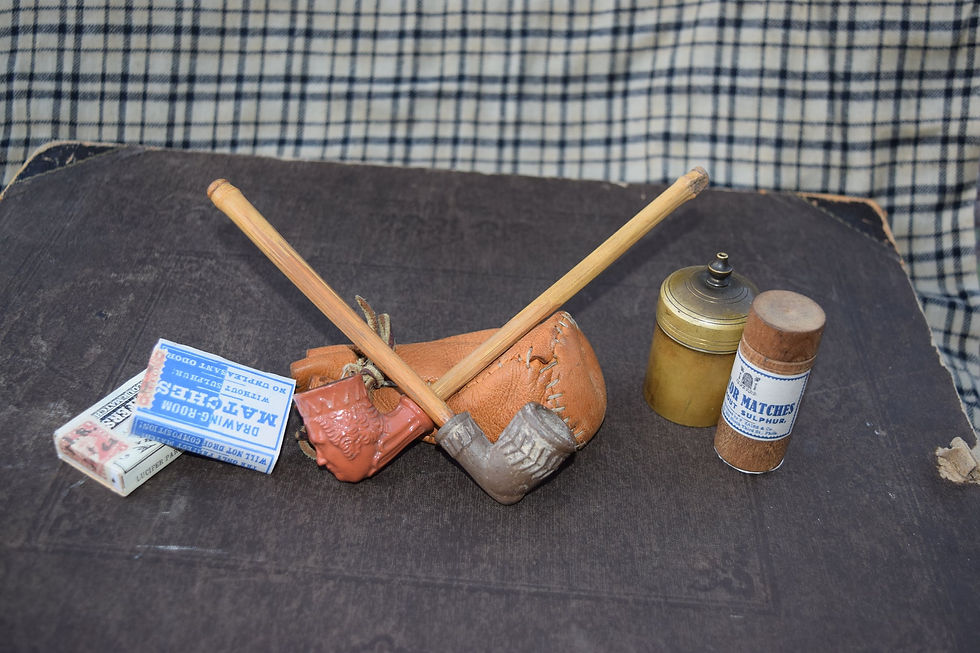
Tobacco use was widespread in 1800's America. The most common forms of consumption was through pipe-smoking and chewing. Photo below features 1830-50's era reed stem pipes with facimile 1860s matchboxes and original matchsafes.
Pocket Revolvers
"An armed society is a polite society." Similar to 21st century American Westerners, many 19th century Americans carried arms, and the preferred method then as now, is to carry a smaller, concealed firearm. When consulting 19th century ledgers and manufacturing records, "pocket revolvers" were far more common than "belt" or "holster/horse" revolvers.

The essentials of travel: Laying on top of steamship tickets, shipping receipts, and bills of lading, a Colt's patented pocket revolver would be a good deterrent against footpads and robbers while in seaports of California, Central America, The Gulf Coast, Cuba, and the eastern US. Note the Central American gold coin.

ITEMS FOR THE PACK
While not commonly carried in pockets, here are some personal items commonly carried in saddlebags, bedrolls, or knapsacks.
Huswife (sewing & hygiene kit)
"Huswife/Housewife" is common slang for a personal hygiene and sewing kit that soldiers, sailors, miners, cowboys, teamsters, and other travelers would carry with them. It commonly contained items like pins, needles, buttons, thread, thimbles, patching, scissors, tweezers, toothbrush, mirror, razor, comb and/or hairbrush.

Leather Kit
A common item with hunters and plainsmen is the leather sewing kit. This allows the traveler to repair buckskin clothing, shoes, saddles, and other leather gear. The kit here contains an awl with heavy-duty leather needles in case, waxed linen, sinew, thong, and patching buckskin along with spare whetstone, striker and flint.

Medicines
Small medicine chest. this will fit in a knapsack or saddlebag. It includes bandages of various sizes with gauze. Peppermint oil for gastric complaint. Mountain Mint (oil of oregano) is both a topical treatment and immune system booster. Pennyroyal, topical insect repellent. The unicorn drops assist with digestive issues and the worm losenges treat intestinal parasites. The Blue Mass is for constipation relief.

Overview of a Traveler's Bullet Pouch
I detailed the bullet pouch in a previous article so this description will be brief. An 1850's era traveler's bullet pouch would contain the necessary tools, ammunition and primers for the firearms, along with leather sewing kit, compass, tinder box, matchsafe, telescope and guide books.

Essential Items of a Frontier Traveler
While Hollywood often portrays the frontier traveler as elaborately attired, functionality was more important for the long journey. Featured below is a typical belt rig from the 1850's. It includes Colt's patented revolver in a California holster with German silver handled Bowie knife. Other useful items would be the various guidebooks published for the Western trails along with binoculars and camp knives, compass and matchsafe.

How do these items look today?
The majority of these items have been replaced by smart phones. All of your journaling, bookeeping, planning, accounting, correspondence and media access are contained in a lightweight package. Couple that with a Kershaw knife and a Bic lighter and you're all set as long as you don't lose power or signal.
Technology is great but the lesson is to not rely too much upon it. There are modern versions of the traditional tools that you saw in this article. It is better if you can use the traditional means to find your way, make fire, make shelter, and survive in an uncertain world regardless if the lights stay on or not. In cases like this, our ancestors have the answers.
-DR


